
The PlayStation 2 Supercomputer
Sony’s 100 Pound Rendering Monster

Dr. Aki drifts through a zero gravity spaceship. Her hair floats weightlessly, catching the soft reflections that ripple across her suit. It looks like a scene from a movie, specifically Final Fantasy: The Spirits Within, unfolding with the precision and polish of a high-end cinematic production. Then, someone picks up a controller.
The camera shifts, and lighting adjusts. The entire scene responds in real time.
This isn’t pre-rendered. It’s not a cutscene or a playback. It’s happening live, rendered at full HD resolution and 60 frames per second.
And this was the year 2000, a time when video games were nowhere near capable of visuals like this.
That summer, Sony unveiled a machine unlike anything the world had seen before. Sixteen PlayStation 2 systems were fused into a single black cube, not designed as a console or a workstation, but as a real time graphics supercomputer built to erase the line between games and film.
They called it the GScube.

Weighing over 100 pounds, this 17 inch cube fit a server rack and glowed with blue LEDs. Built more like a server than a console, it earned the nickname “The Fridge.” Inside, it housed 16 enhanced PlayStation 2 boards working in parallel. Each board contained a custom “I 32” Graphics Synthesizer, an upgraded version of the PS2’s original GPU with eight times the video memory, paired with 128 MB of Direct RDRAM and an Emotion Engine CPU running at 294.912 MHz.
The combined system delivered 2 GB of RAM, 512 MB of video RAM, 97.5 GFLOPS of floating point performance, and a theoretical throughput of 1.2 billion polygons per second. It pushed real time visuals at 1920 by 1080 resolution and 60 frames per second. For perspective, the PlayStation 3, released years later, peaked at around 200 GFLOPS and 250 million polygons per second. The GScube’s brute force architecture placed it in an entirely different class, achieving performance that consumer hardware wouldn’t match for years.
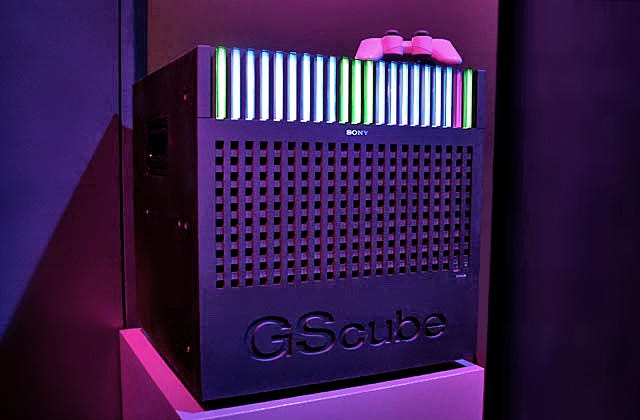
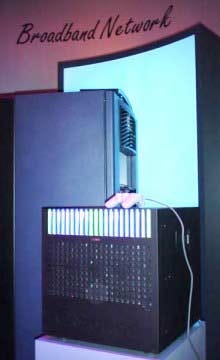
Rather than operate as a standalone system, the GScube relied on a Silicon Graphics Origin 3400 server, which handled geometry, textures, and logic. Data was fed into the cube using a custom 1024 bit data bus alongside a 32 bit control bus. The GScube’s sole purpose was to render graphics at the highest possible quality in real time.
To prove what that looked like, Sony partnered with elite graphics studios and took the GScube to SIGGRAPH.
Inside Sony’s booth, attendees entered a dark theater space where four real time demos played in rotation. Each one rendered interactively using film assets or complex 3D scenes live.
Square Pictures ran a scene from Final Fantasy: The Spirits Within with Aki Ross aboard a zero gravity ship. The camera could be rotated freely, revealing dynamic lighting, motion blur, and 314,000 polygons all in real time at 60 fps in full HD. According to Square, the scene normally took five hours per frame to render.
Manex and Warner Bros. recreated The Matrix’s bullet time shot using actual film assets. Viewers could pan, pause, and move the camera mid scene. John Gaeta, the film’s VFX supervisor, called it a look into the future of virtual cinematography.
Pacific Data Images (DreamWorks) showed off a modified scene from Antz using a version of RenderWare 3, by Criterion, adapted to run across all 16 PS2 boards. Inside a 3D barroom, 140 animated ants, each with 7,000 polygons, moved and interacted, totaling over a million polygons per frame. The scene ran live, and Criterion estimated a real world rendering rate of 65 million polygons per second.
Silicon Studio and Intrinsic Graphics created a real time flight simulator rendered at 1080p and 60 fps, showing the GScube’s suitability for aerospace, simulation, and IMAX compatible digital projection. The implication was that film quality visuals could be streamed and rendered live over broadband.
These weren’t mere tech demos. The PS2 era’s technology, scaled up, accomplished tasks that once demanded massive render farms.
The GScube’s internals were divided into four blocks of four rendering units. Their output was merged into one synchronized video stream by custom chips. Its 21 LED indicators, 16 for render modules and five for system logic, glowed blue when idle, green under load, and white at full capacity. It looked like an art installation but performed like a monster.
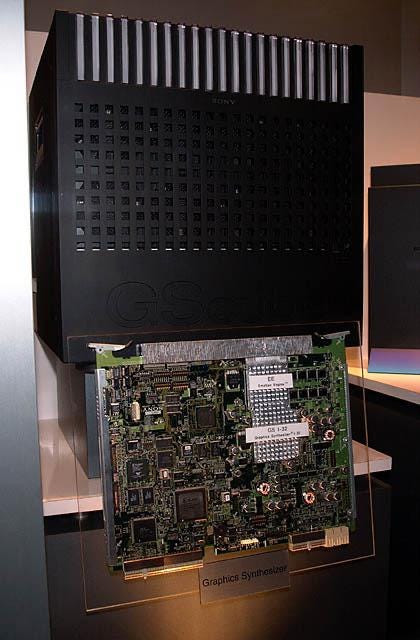
It wasn’t plug-and-play, or even remotely consumer-ready. But it worked. And at SIGGRAPH, it worked flawlessly.
The GScube was the realization of Ken Kutaragi’s long term vision. Years earlier, he had pitched a modular rendering system called “Parallel o PlayStation.” The GScube was a physical manifestation of that dream, using developer grade PS2 boards engineered specifically for extreme rendering. Kutaragi even envisioned a future 64 node GScube Plus with four times the rendering units. Theoretically, it would push over 4 billion polygons per second and render fully CG films like Final Fantasy in real time, strand by strand.
But the vision hit practical limits. Feeding 16 GPUs was already a monumental task. Scaling to 64 required vast bandwidth, server upgrades, and enormous cost. Sony used a top tier SGI Origin 3400 with up to 12 MIPS R12000 CPUs just to run the demo version.
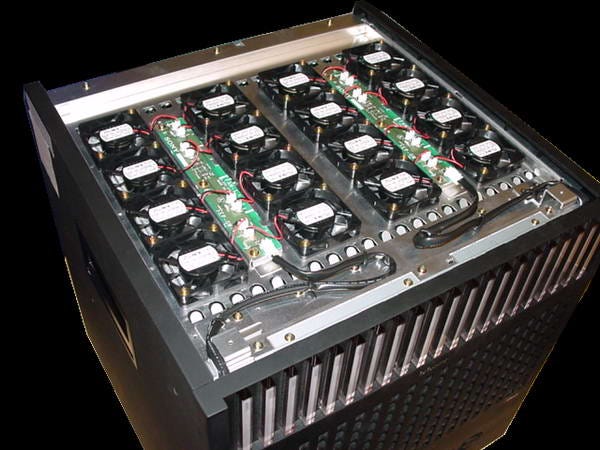
As PC graphics caught up, the GScube’s relevance wore off, and Sony quietly ended the project. Prototypes were shipped back to Japan, likely disassembled, and never sold.
But the GScube influenced future PlayStation architectures, especially the PS3’s Cell processor, and introduced rendering concepts that became standard in virtual cinematography and live previsualization. Its demos foreshadowed game engine advancements in Unreal and Unity, inspiring competitors to push real-time rendering toward cinematic quality and fueling a broader industry shift toward interactive, film-like experiences.
This was PlayStation at its most fearless. A glimpse into a future that almost happened.